The New £10 Note
NOTE: Based on information posted on the Bank of England website in 2000.
This page first posted in the same year, and revised 1 May, 2015.

© The Governor and Company of the Bank of England 2000
As is appropriate for a banknote celebrating the life and work of a naturalist, animal and plant imagery is used throughout the note.
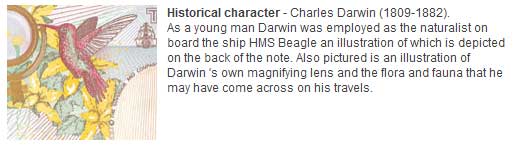
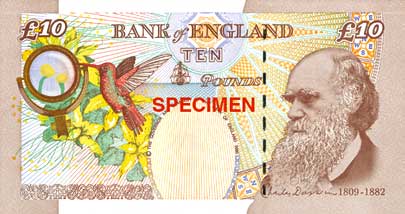
On the back of the note, the left-hand side is taken up with an image of a humming bird feeding on yellow blooms. The humming bird is based on the type characteristically found in the region of the Galapagos [sic, Galápagos] Islands, coloured in the banknote's predominant colour scheme. The flowers are shown magnified in Darwin's own lever compressor lens, now preserved at Down House, Darwin's home, highlighting the use that Darwin made of observations of living species. Immediately below the flowers is an ornamental border, based on the decoration on Darwin's own spill-holder, also kept at Down House.
Some fossil evidence was known to Darwin. An extinct type of marine creature - ammonites - are mentioned in the text of "On the Origin of Species by Means of Natural Selection". He also cited trilobites as examples of groups of creatures that had become extinct in his discussion on selective pressures. Fossil ammonites and trilobites are included in the background details on the front of the note.
There are no hummingbirds in Galápagos—not now, not ever; never. In response to an e-mail inquiry to the bank, a spokesperson offered the following explanation:
All of the Bank's banknotes reflect the designer's interpretation of aspects of the life and work of the chosen featured personality. We have to temper historical accuracy with the technical requirements and limitations imposed by banknote design, and at the same time, produce something that is artistically pleasing.
The spokesperson did not say why an iguana—or perhaps even a blue-footed booby—would compromise the bank's technical requirements, and so had to yield to a non-existant (though no doubt artistically pleasing) hummingbird.
15 November, 2008—Some eight years after “Darwin's Hummingbird” made its debut, The Guardian website posted “Darwin art strikes wrong note” in which Professor Steve Jones, University College, London, remarked that “putting a hummingbird on the current £10 note was a blunder.” In response, the bank simply repeated that the hummingbird was of “the type characteristically found in the region of the Galapagos [sic, again] Islands.”
Some time later (date unknown), the Bank of England text above was at last revised, as seen here: